Фарм и ресурсы
Farming Guide (2024)

If you haven't yet found the right RUST guide for growing pumpkins, sweetcorn and potatoes in Rust, then you should take a look here. Among other things, I deal with the questions: - Where can I find what? - How do I grow plants? - What tools do I need? -
Introduction


 Rust-Collection Rust-Collection Rust-Collection
Guide to Food Sources and Planting in Rust
To survive in Rust, you need a variety of food sources such as meat from hunted animals, found fruits from crates, and gathered vegetables and berries. This guide focuses on the latter – vegetables and berries. Oh, and also hemp, which isn't edible but can be collected and planted in your own greenhouse.
Reproduction of Plants
It should be noted that homegrown pumpkins, corn, potatoes, and berries will provide seeds for further cultivation after consumption, while hemp does not.
Biomes and Plant Locations
The different biomes (habitats/landscapes) span across the Rust map. Typically, the snow biome is on one side of the map, the desert biome on the other, and the temperate and forested areas are in the middle.
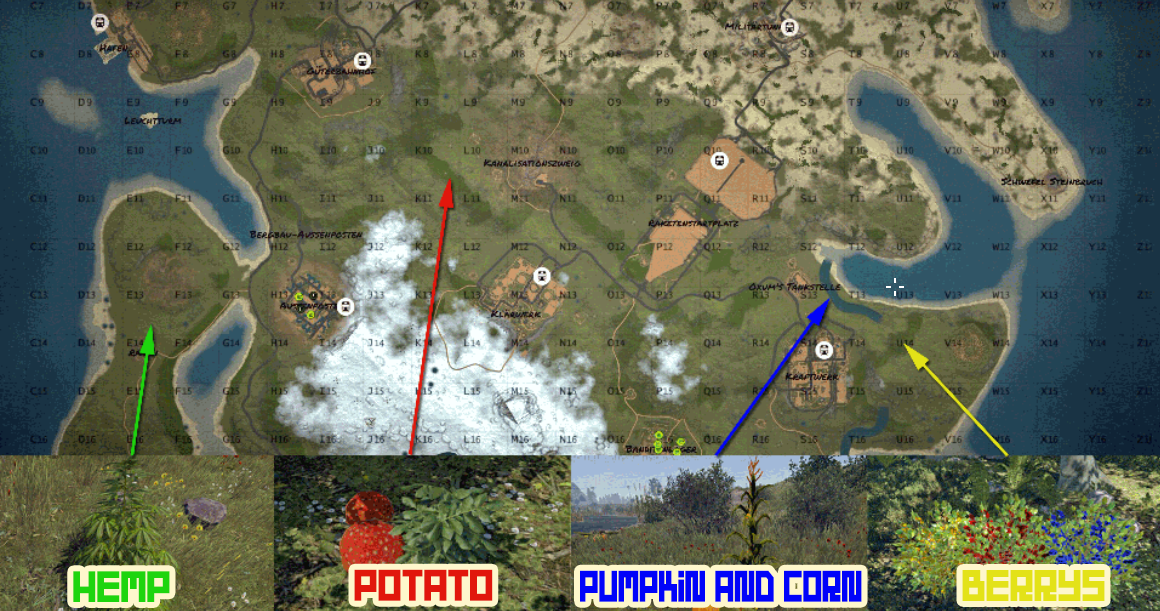
You can find the plants suitable for cultivation in your greenhouse in the following locations on the Rust map:
- Hemp: Found everywhere except in snow biomes.
- Potatoes: Found in densely forested areas (the dark green regions on the map).
- Pumpkin & Corn: Found along rivers, except in snow biomes.
- Berries: Found in densely forested areas (the dark green regions on the map).
Seeds
Potatoes are highly resilient and can grow well in most environments. However, they offer slightly fewer healing and hydration points when consumed compared to pumpkins.
 |  |  |  |  | |
|---|---|---|---|---|---|
| Pumpkin Seeds | Corn Seeds | Potato Seeds | Hemp Seeds | Berry Seeds | |
| Water Resistance | 15% | 15% | 30% | 15% | 20% |
| Light Resistance | 10% | 10% | 30% | 10% | 20% |
| Soil Resistance | 10% | 10% | 30% | 10% | 20% |
| Temperature Resistance | 10% | 10% | 30% | 10% | 20% |
Requirements
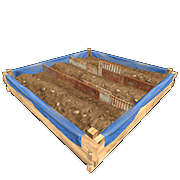
For growing your own Rust vegetables, you will first need planters. I recommend using large planters, as they fit perfectly within the size of a foundation and can be optimally lit and watered with a lamp and a sprinkler respectively.
You can also walk over the large planters, so the smaller ones aren't necessarily needed unless your base only has space for the smaller variant.
You can purchase the large planter for 30 scrap at the Bandit Camp or craft it yourself if you have the necessary blueprint.
Goal
To achieve maximum yield in your greenhouse, it is essential to optimize the following factors in each of your planters:
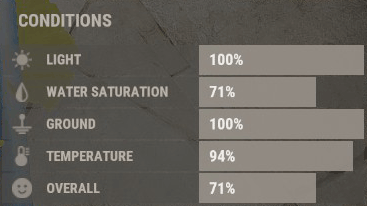
Additionally, you can see the overall value in the info box for your plants (Overall).
Factors that positively influence these values include:
➥ Water: The amount of water
➥ Light: Daylight or hanging lamp
➥ Ground: Fertilizer
➥ Temperature: The environment (cold/hot)
The required amount of water varies for different types of plants. For example, the optimal amount of water in the planter for berries and pumpkins is as follows:
- Water
- Light
- Ground
- Temperature
Additionally, you can see the overall value in the info box for your plants (Overall).
Factors that positively influence these values include:
➥ Water: The amount of water
➥ Light: Daylight or hanging lamp
➥ Ground: Fertilizer
➥ Temperature: The environment (cold/hot)
The required amount of water varies for different types of plants. For example, the optimal amount of water in the planter for berries and pumpkins is as follows:
| Plant Type | Optimal Water Amount | Percentage |
|---|---|---|
| Berry Seeds | 4300 ml - 7200 ml | 47%-80% |
| Pumpkin Seeds | 4500 ml - 6300 ml | 50%-70% |
Irrigation
To water your planters, you first need to collect water. This can be done using either the large or small water catchers (rainwater) or, newly available, the electric water pump with fresh water (from rivers and lakes) or saltwater (from the sea, but only with a water purifier).
You can use the hose tool to connect water catchers/water pump, water barrel, and sprinkler to supply your planters with water. If possible, let gravity work for you. If your water catchers, water barrel, and sprinkler are arranged vertically in your base (roof, first floor, ground floor), you won't need a pump for the connections between them. However, if you need to pump water against gravity, you will require electricity and appropriate pumps. This will also be indicated when using the hose tool.
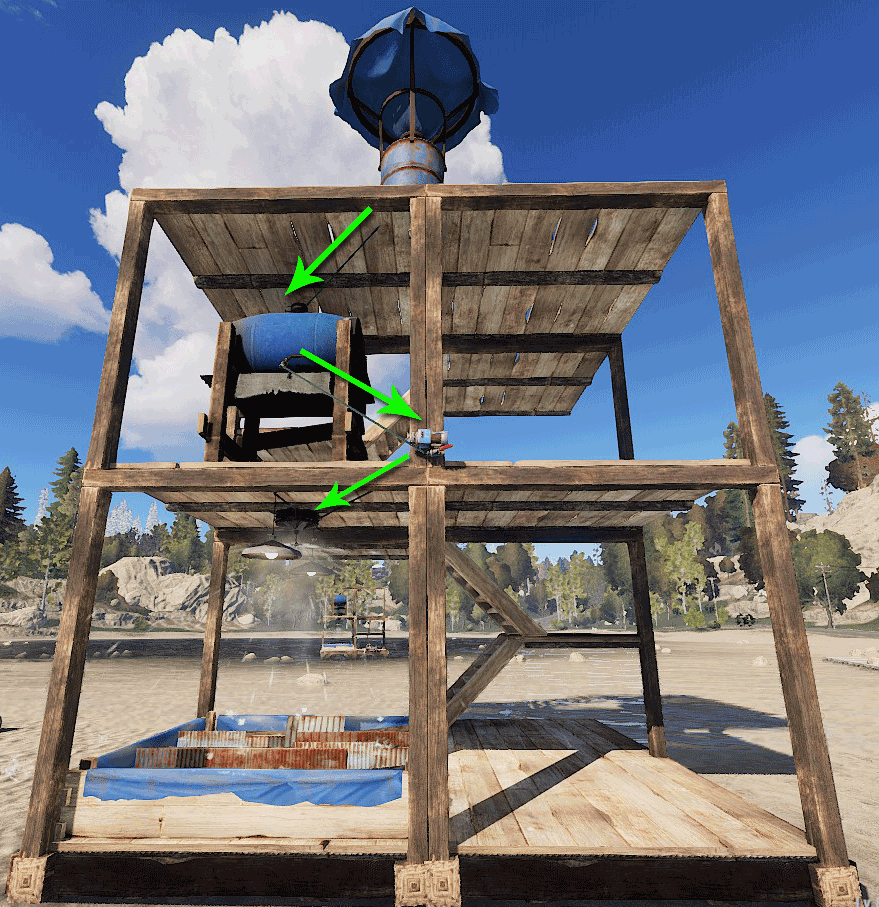
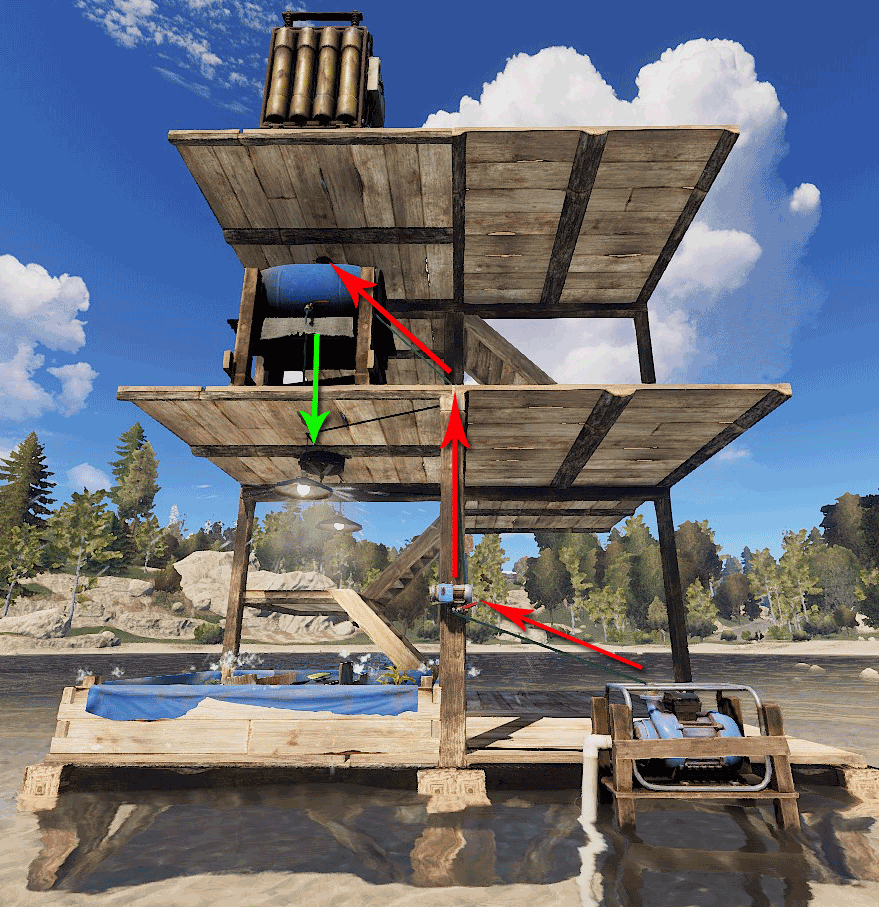
Neither the large nor the small water catchers can provide enough water to continuously operate enough sprinklers for a larger greenhouse. However, the large water catcher can almost continuously run two sprinklers.
★ Large Water Catcher ➫ Large Water Catcher ➫ Water Barrel ➫ 3-4 Sprinklers ➫ 3-4 Planters
★ Water Pump ➫ Water Barrel ➫ 3-4 Sprinklers ➫ 3-4 Planters
The main difference is that the water pump provides a continuous and greater amount of water than the water catchers. However, two large water catchers also supply a substantial amount of water over time if you use/irrigate your planters sporadically.
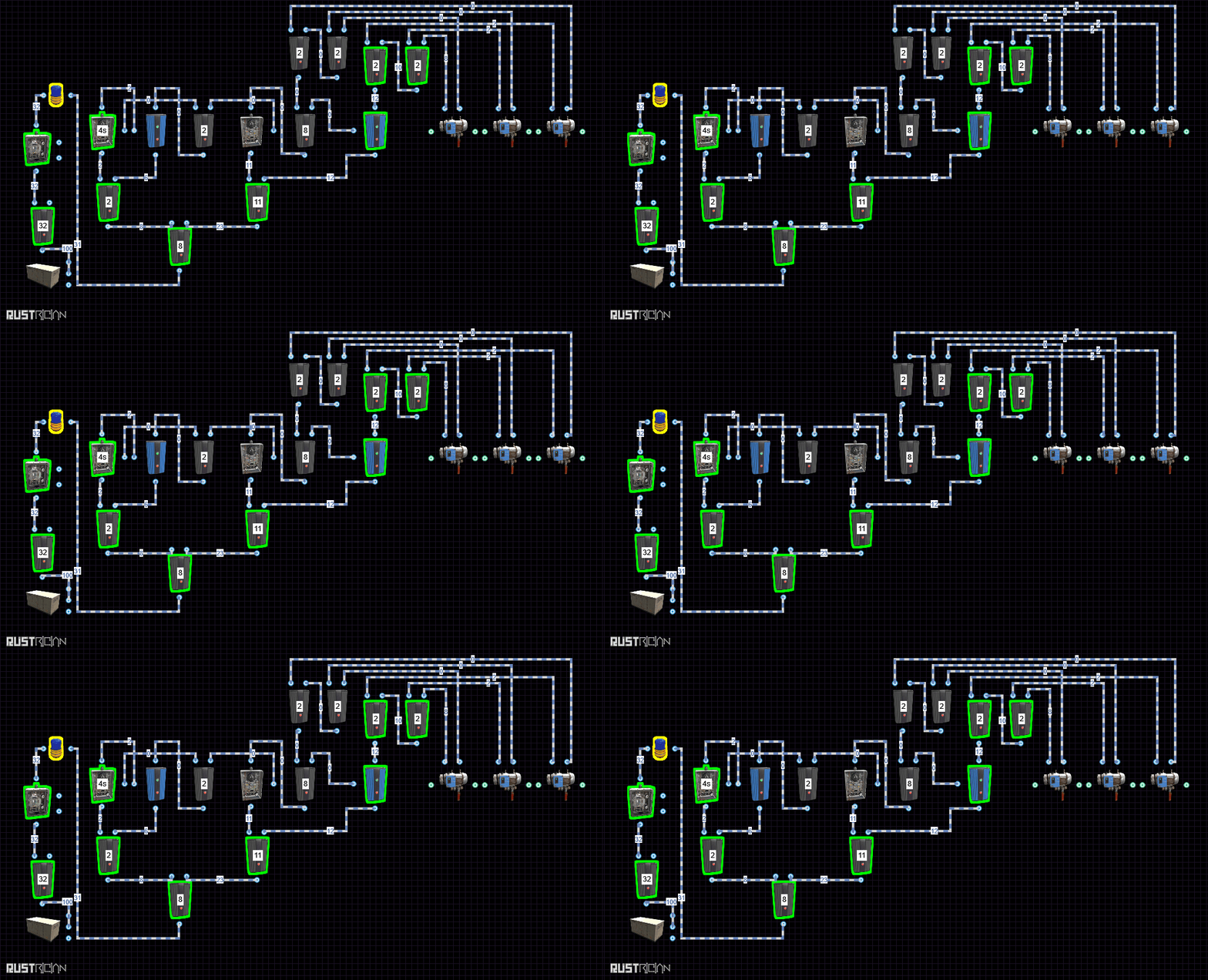
External link: This circuit at rustrician
You can use the hose tool to connect water catchers/water pump, water barrel, and sprinkler to supply your planters with water. If possible, let gravity work for you. If your water catchers, water barrel, and sprinkler are arranged vertically in your base (roof, first floor, ground floor), you won't need a pump for the connections between them. However, if you need to pump water against gravity, you will require electricity and appropriate pumps. This will also be indicated when using the hose tool.
Water Collection
Neither the large nor the small water catchers can provide enough water to continuously operate enough sprinklers for a larger greenhouse. However, the large water catcher can almost continuously run two sprinklers.
Optimal Irrigation
From my experience, optimal irrigation can be achieved with the following setups:★ Large Water Catcher ➫ Large Water Catcher ➫ Water Barrel ➫ 3-4 Sprinklers ➫ 3-4 Planters
★ Water Pump ➫ Water Barrel ➫ 3-4 Sprinklers ➫ 3-4 Planters
The main difference is that the water pump provides a continuous and greater amount of water than the water catchers. However, two large water catchers also supply a substantial amount of water over time if you use/irrigate your planters sporadically.
Caution with Saltwater❢
You must fill your planters exclusively with fresh water! If your planter contains fresh water and you add even a small amount of saltwater, the water amount immediately drops to 0, and you will have to start refilling with fresh water from scratch.Irrigation Control
To avoid wasting too much water, I installed a timer between the water barrel and the sprinklers. The sprinklers provide water for 5 seconds and then pause for 5 seconds. This prevents the water barrels from emptying too quickly and allows the water sources (water catchers, pumps) to refill them.External link: This circuit at rustrician
Lighting
For lighting your planters, you need either direct sunlight or, even better, a ceiling light for each planter. Ceiling lights are preferable as they can provide continuous light (day and night).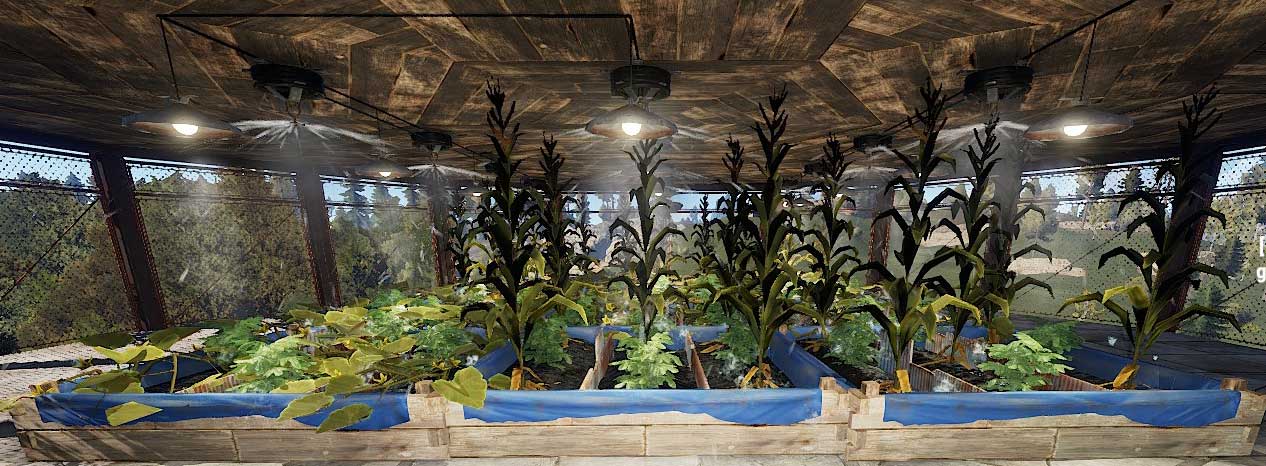
Growth Stages
The plants in your planter go through the following growth stages:
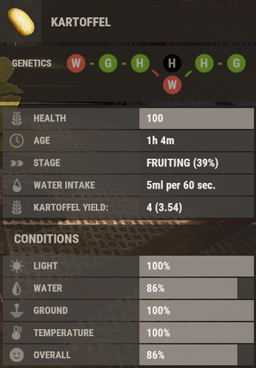
At the beginning, it's unfortunately impossible to tell how long each growth stage will last. However, the GUI for your planter will show the percentage of completion for each stage. The duration depends on the current conditions and the plant's genetics. It's also good to know that the displayed time is "real-time" and not the day/night cycle in Rust. So, 3-4 hours of growth means 3-4 hours of gameplay ;)
You can view the growth stages in your planter with an empty hand. The first two phases, Seedling and Sapling, are less interesting than the third stage, Crossbreed. From this phase, you can observe the genetics of your future plants to determine if they might become more robust or productive. More about this in the "Genetics" chapter.
In the Mature phase, plants start increasing their yield. From the Fruiting stage, you can begin harvesting fruits or clones. The Ripe phase is less interesting, but it's when the plants reach their maximum yield. This is the phase where you should harvest, because in the final Dying phase, you can only collect plant fibers for your composter.
After that, the remnants of your harvest will disappear, leaving only empty planters.
- Seedling
- Sapling
- Crossbreed
- Mature
- Fruiting
- Ripe
- Dying
At the beginning, it's unfortunately impossible to tell how long each growth stage will last. However, the GUI for your planter will show the percentage of completion for each stage. The duration depends on the current conditions and the plant's genetics. It's also good to know that the displayed time is "real-time" and not the day/night cycle in Rust. So, 3-4 hours of growth means 3-4 hours of gameplay ;)
You can view the growth stages in your planter with an empty hand. The first two phases, Seedling and Sapling, are less interesting than the third stage, Crossbreed. From this phase, you can observe the genetics of your future plants to determine if they might become more robust or productive. More about this in the "Genetics" chapter.
In the Mature phase, plants start increasing their yield. From the Fruiting stage, you can begin harvesting fruits or clones. The Ripe phase is less interesting, but it's when the plants reach their maximum yield. This is the phase where you should harvest, because in the final Dying phase, you can only collect plant fibers for your composter.
After that, the remnants of your harvest will disappear, leaving only empty planters.
Fertilizer
To accelerate the growth of your plants, you can produce fertilizer using a composter.
You can place collected bones and horse manure into the composter to produce fertilizer. Each pile of horse manure yields 5 units of fertilizer. Additionally, you can process other "food items" – whether raw, cooked, spoiled, or even burnt – into fertilizer in your composter.
You can find a fertilizer calc here

However, I must also mention that only horse manure provides a good yield with a 1:10 ratio (1 x horse manure = 10 fertilizer). For all other "ingredients," the best result you can achieve is a 5:1 ratio (e.g., 5 x apple = 1 fertilizer). The only exception is caught fish, which yields a factor of 0.8. However, fish are too valuable as a source of food and fat to waste on composting.
When you add fertilizer to your planters, each plant slot will consume 1 unit of fertilizer for the entire growth cycle of your plant.
You can place collected bones and horse manure into the composter to produce fertilizer. Each pile of horse manure yields 5 units of fertilizer. Additionally, you can process other "food items" – whether raw, cooked, spoiled, or even burnt – into fertilizer in your composter.
You can find a fertilizer calc here
However, I must also mention that only horse manure provides a good yield with a 1:10 ratio (1 x horse manure = 10 fertilizer). For all other "ingredients," the best result you can achieve is a 5:1 ratio (e.g., 5 x apple = 1 fertilizer). The only exception is caught fish, which yields a factor of 0.8. However, fish are too valuable as a source of food and fat to waste on composting.
When you add fertilizer to your planters, each plant slot will consume 1 unit of fertilizer for the entire growth cycle of your plant.
Harvest
The result of your harvest will depend on the type of seeds you used: pumpkins, corn, potatoes, or berries. Their nutritional value varies, but you shouldn't focus solely on the most productive vegetable. A mixed planting of your planters can yield a better overall harvest.
| Vegetable |  |  |  |  |
|---|---|---|---|---|
| Healing | +6 | +10 | +6 | +0 |
| Calories | +75 | +100 | +125 | +5 |
| Hydration | +10 | +30 | +5 | +2 |
When harvesting hemp, you will only receive cloth.
Genetics
By far the most advanced, yet also the most complex addition to the farming update is that plants now have genes.
When you collect seeds of different plant types in the wild, you cannot see their genes. Only when you plant them in your planters will the exact genotypes be displayed. Each plant has 6 gene slots. The type of genes the plant will have is randomly generated upon planting. Generally, green genes (G, Y, H) are good, while red genes (W, X) are bad for further propagation of your plants.
The currently possible genotypes are:
If you want to cultivate a different gene strand than the original, you need to grow several plants side by side, hoping that the genes of one plant will overwrite the others through crossbreeding.
You can easily calculate the best seed with the Clone Calc Card

When you collect seeds of different plant types in the wild, you cannot see their genes. Only when you plant them in your planters will the exact genotypes be displayed. Each plant has 6 gene slots. The type of genes the plant will have is randomly generated upon planting. Generally, green genes (G, Y, H) are good, while red genes (W, X) are bad for further propagation of your plants.
The currently possible genotypes are:
- G = Increased Growth Rate
- Y = Increased Yield Rate
- H = Increased Hardiness
- W = Increased Water Consumption
- X = Empty
If you want to cultivate a different gene strand than the original, you need to grow several plants side by side, hoping that the genes of one plant will overwrite the others through crossbreeding.
Cloning
Cloning is used when a player likes the specific gene strand of a plant. A cloned plant is exactly like the original and inherits all its genes. |  |  |  |  |
|---|---|---|---|---|
| Corn Clone | Pumpkin Clone | Potato Clone | Hemp Clone | Berry Clone |
You can easily calculate the best seed with the Clone Calc Card
Thanks to
This guide is a translation of the guide: German to English
https://steamcommunity.com/sharedfiles/filedetails/?id=2073049054
Rust-Collection Rust-Collection Rust-Collection
https://steamcommunity.com/sharedfiles/filedetails/?id=2073049054
Rust-Collection Rust-Collection Rust-Collection
Комментарии 0
Войди через Discord, чтобы комментировать